
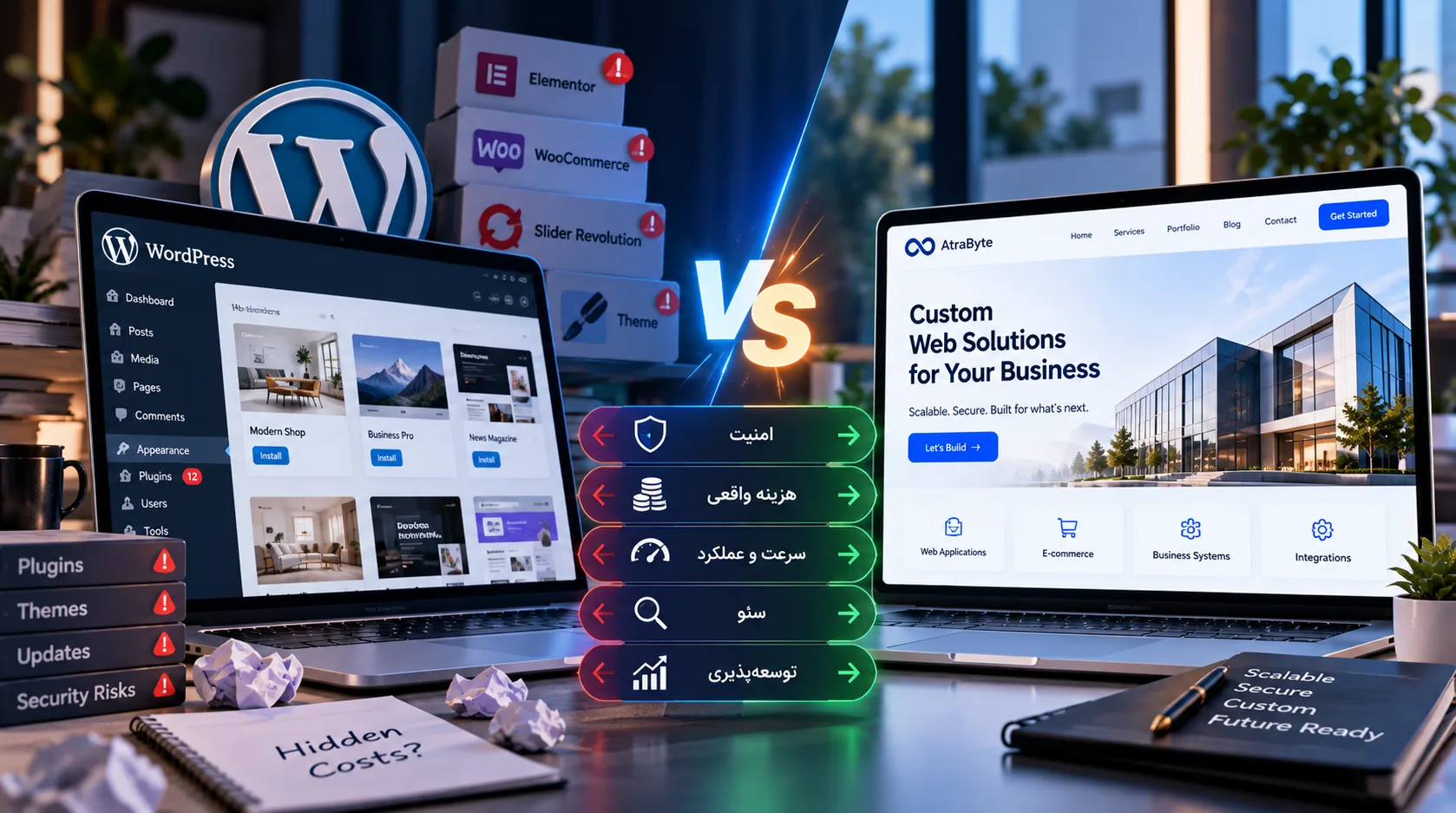
A cheaper website is not always cheaper to own. And custom code is not automatically more secure.
Imagine receiving two proposals for your business website.
The first uses WordPress with a ready-made theme. It costs less upfront and promises a faster launch.
The second involves a custom-designed website with features built around your business requirements. The initial investment is higher, and development takes longer.
Which one should you choose?
The answer becomes more complicated when you consider security, maintenance, search engine optimization, future features, and long-term costs.
The critical PHP vulnerabilities disclosed in October 2026 have made this question particularly relevant.
Let's examine what happened and how to make a practical decision without relying on misleading claims about either technology.
What Happened in October 2026?
On October 21, 2026, two critical vulnerabilities in the PHP runtime were publicly disclosed:
-
CVE-2026-109618
-
CVE-2026-109619
Both received a CVSS v4 severity score of 9.2.
Successful exploitation could allow remote code execution or unauthorized access to sensitive process memory.
PHP is widely used by content management systems such as WordPress, Drupal, and Joomla, as well as custom applications.
However, these vulnerabilities were found in PHP itself, not specifically in WordPress core or a particular theme.
A custom application running on a vulnerable PHP runtime may also be affected.
WordPress.org explicitly stated that updating WordPress itself would not resolve these PHP vulnerabilities.
Which PHP Versions Received Fixes?
| PHP Branch | Patched Version |
|---|---|
| 8.5 | 8.5.12 or later |
| 8.4 | 8.4.27 or later |
| 8.3 | 8.3.36 or later |
| 8.2 | 8.2.35 or later |
PHP 8.1 and earlier no longer receive security updates from the upstream PHP project.
Some operating-system vendors may backport fixes to their supported packages, so administrators should check vendor advisories as well as version numbers.
The lesson is clear: website security depends on the entire software stack, not just the platform used to build the visible pages.
Understanding WordPress, Ready-Made Themes, and Custom Development
What Is WordPress?
WordPress is an open-source content management system that helps people publish and manage websites.
It supports blogs, company websites, online stores, and many other projects.
Importantly, WordPress does not necessarily mean using a ready-made theme. Developers can create custom themes, plugins, and integrations.
What Is a Ready-Made Theme?
A ready-made theme provides predefined layouts, visual components, and styling options.
Themes can make development faster and more affordable.
However, some themes include features or dependencies that a particular business does not need.
Quality varies considerably between products.
What Is a Custom Website?
A custom website is designed and developed around defined business requirements.
Developers may use established frameworks such as Django or Laravel instead of a general-purpose CMS.
Custom development does not mean writing every component from scratch. Professional projects also depend on frameworks, packages, and third-party services.
The distinction is primarily about control over architecture, business logic, and user experience.
WordPress vs. Custom Development: Comparison
| Factor | WordPress With Theme | Customized WordPress | Custom Development |
|---|---|---|---|
| Initial cost | Often lower | Moderate to high | Often higher |
| Launch time | Often shorter | Project-dependent | Project-dependent |
| Design flexibility | Theme-dependent | High | High |
| Complex workflows | Plugins or custom code | Custom extensions | Purpose-built logic |
| Security | Depends on implementation | Depends on implementation | Depends on implementation |
| Performance | Can be optimized | Can be optimized | Can be optimized |
| SEO | Fully possible | Fully possible | Fully possible |
| Maintenance | CMS, plugins, themes, hosting | CMS plus custom code | Code, dependencies, infrastructure |
No option wins every category.
1. Security: Is Custom Development Safer?
WordPress has a large ecosystem of themes and plugins.
Every additional component can introduce dependencies and potential vulnerabilities.
Outdated or poorly maintained plugins can increase security risks.
However, this does not make WordPress inherently insecure.
A properly maintained WordPress installation using trusted extensions, supported software, strong authentication, and sensible permissions can provide appropriate security for many businesses.
Custom development offers the opportunity to choose only necessary components and implement business-specific security controls.
But custom code can also contain authentication failures, access-control mistakes, injection vulnerabilities, or insecure dependencies.
Security is the outcome of engineering practices, testing, monitoring, and maintenance, not the label attached to the platform.
2. Hidden Costs: What Does a Website Really Cost?
Ready-made themes often reduce the initial investment.
However, website ownership includes more than launch costs.
Businesses may need to pay for:
-
Premium theme and plugin renewals
-
Hosting and infrastructure
-
Security updates and support
-
Plugin compatibility fixes
-
New features and integrations
-
Performance optimization
-
Redesigns or migrations
Custom websites also require maintenance, dependency updates, testing, and ongoing technical support.
Illustrative Three-Year Cost Comparison
Consider a fictional business evaluating two solutions.
| Cost | Theme-Based Site | Custom Website |
|---|---|---|
| Initial development | $1,000 | $4,000 |
| Annual maintenance | $600 | $750 |
| Changes over three years | $2,250 | $750 |
| Three-year total | $5,050 | $7,000 |
These figures are illustrative assumptions, not market averages or quotations.
In this scenario, the theme-based solution remains less expensive.
Different requirements could produce different results.
The correct comparison is the total cost of ownership (TCO), including development, operation, maintenance, future changes, and migration.
3. Performance: Is WordPress Slower?
Not necessarily.
Website speed depends on code quality, server performance, caching, image optimization, database efficiency, and resource loading.
A well-optimized WordPress website can perform very well.
A poorly developed custom website can be slow.
Google's Core Web Vitals help evaluate important aspects of user experience:
-
LCP: Loading performance
-
INP: Responsiveness to user interactions
-
CLS: Visual stability
Measure actual performance rather than assuming one technology is faster.
4. SEO: Does Google Prefer Custom Websites?
Google does not automatically reward websites for using custom code rather than WordPress.
Both approaches can support effective technical SEO.
WordPress provides tools for managing metadata, sitemaps, URLs, and content.
Custom systems can implement the same capabilities with more direct architectural control.
However, a custom site with incorrect canonical tags, inaccessible links, or poorly handled JavaScript may perform badly in search.
For multilingual websites, separate language URLs, appropriate hreflang annotations, localized content, and consistent canonical handling are particularly important.
SEO depends on implementation quality, content usefulness, and the overall search experience.
5. Design and User Experience
Ready-made themes are designed to work for many businesses.
This makes them convenient but can create limitations when a company needs an unusual customer journey.
For example, a furniture retailer may need a product configurator that combines dimensions, fabrics, colors, and dynamic pricing.
If available themes and plugins cannot support the experience reliably, custom development may be justified.
Still, a custom design should be based on real user needs, not visual novelty alone.
6. Scalability and Future Features
Business requirements change over time.
A company may eventually need customer loyalty programs, advanced inventory management, CRM integration, custom reporting, or automated internal processes.
WordPress can support many of these capabilities through extensions and custom development.
However, when workflows become highly specialized, architectural constraints and maintenance costs deserve closer examination.
Sometimes a dedicated application is appropriate. In other cases, WordPress connected to a separate service is more practical.
The best architecture depends on the problem.
7. Ownership and Vendor Lock-In
Paying for a website does not automatically mean owning every component.
Businesses should clarify:
-
Who controls the domain?
-
Who can export customer and order data?
-
What rights apply to custom code?
-
Which licenses govern third-party themes and plugins?
-
Who controls hosting, backups, and deployment?
-
Can another development team maintain the project?
WordPress is open-source, but commercial extensions may have their own licensing terms.
Custom development contracts should also explicitly define intellectual property rights and handover obligations.
8. Maintenance Is Not Optional
Launching a website is only the beginning.
WordPress sites require updates to core software, themes, plugins, PHP, and infrastructure.
Custom websites require framework updates, dependency management, security testing, database maintenance, and infrastructure monitoring.
Both approaches need reliable backups, recovery procedures, and incident-response planning.
A provider's maintenance process is often more important than their preferred programming language.
9. Dependency on Plugins or Developers
Theme-based websites may depend heavily on particular commercial extensions.
If a vendor stops supporting an essential plugin, replacement can become expensive.
Custom websites face a different risk: dependency on a single developer or agency.
Documentation, automated tests, repository access, and clear ownership agreements can reduce that risk.
When Should You Choose WordPress?
WordPress is often a good fit when your business needs a content-focused website, a standard online store, or a company website with familiar features.
It can be especially attractive when launch speed, content management, and a limited initial budget are important.
Choose reputable extensions and establish a maintenance plan.
When Is Custom Development Worth It?
Custom development becomes more compelling when a business needs unusual workflows, complex permission structures, specialized ordering logic, deep system integrations, or significant future product development.
It may also be suitable when the organization requires precise control over application architecture and user experience.
Before commissioning custom software, compare existing products and hybrid architectures.
Security Checklist After the October 2026 PHP Advisory
-
Identify the PHP runtime used by your website.
-
Confirm that the relevant security fix has been applied.
-
Check official hosting and operating-system vendor advisories.
-
Back up the system and test recovery procedures.
-
Update WordPress, themes, plugins, frameworks, and dependencies as appropriate.
-
Remove unused extensions and accounts.
-
Enforce strong authentication and least-privilege access.
-
Review security logs and investigate signs of compromise.
-
Establish a responsible person or team for ongoing patch management.
If immediate remediation is impossible, assess whether access should be restricted or the affected service temporarily taken offline.
Patching does not replace investigation when compromise is suspected.
Frequently Asked Questions
Is WordPress insecure in 2026?
Not inherently. The October 2026 advisory concerns PHP itself, and security depends on software versions, configuration, and maintenance.
Are custom websites impossible to hack?
No. Any software can contain vulnerabilities.
Are ready-made themes suitable for e-commerce?
Yes, particularly when requirements are standard and the selected products are well maintained.
Is WordPress always slower than custom development?
No. Performance depends on implementation and infrastructure.
Does custom development automatically improve SEO?
No. Both approaches can support excellent technical SEO.
Can a WordPress website be migrated to a custom platform?
Often, yes. Content, URLs, users, orders, and search visibility must be handled carefully.
Conclusion: Choose the Right System, Not the Most Attractive Label
WordPress and custom development are not universal substitutes for each other.
WordPress can be fast to launch, economical, and highly capable.
Custom development can offer greater control when business processes and product requirements justify it.
The October 2026 PHP vulnerabilities highlight a broader truth: security depends on the entire technology stack and the people responsible for maintaining it.
The most useful question is not simply, "Should my website use WordPress or custom code?"
It is: Which solution fits my business, who will maintain it, and how will it support future growth?
At AtraByte, we focus on custom web design and development, practical architecture, user experience, and long-term maintainability.
Discussion
Thoughts on this article