
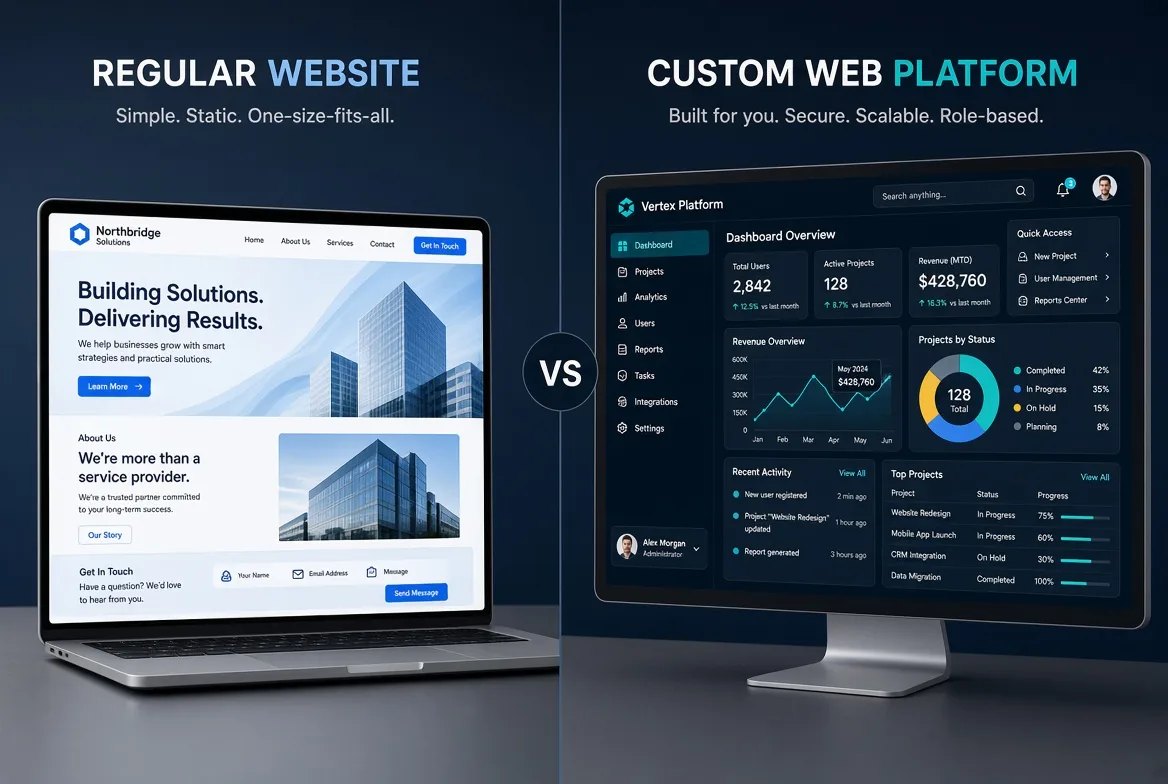
Many businesses face the same question when strengthening their online presence: should they build a regular website or a custom web platform? These two are frequently confused, yet they differ fundamentally in purpose, technical complexity, cost and use cases.
What is a Regular Website?
A regular website is primarily designed to inform. The content is largely the same for every visitor. Users read pages, view products or services, fill out a contact form and then decide to get in touch or make a purchase.
Common examples:
- Company presentation sites
- Content blogs or magazines
- Simple to mid-size online stores
- Portfolios
Typical technology includes HTML, CSS, JavaScript and content management systems such as WordPress. User interaction remains relatively limited and one-directional.
What is a Custom Web Platform?
A custom web platform is essentially software delivered through the browser. Users usually need to log in, store personal or business data and perform specific tasks. The experience is personalized for each user.
Common examples:
- Customer portals (orders, support tickets, invoices)
- Internal management dashboards
- Advanced booking systems with different roles
- Marketplaces
- Internal business tools (inventory, approval workflows, etc.)
Here databases, authentication, business logic, user roles and integrations with other systems play the central role.
Key Differences at a Glance (Approximate Costs in Iran, 1405)
| Criterion | Regular Website | Custom Web Platform |
|---|---|---|
| Primary goal | Inform and convert visitors | Enable users to perform tasks and process data |
| Content shown | Largely the same for everyone | Personalized based on the user account |
| Login required | Usually not | Almost always |
| User interaction | Low (reading, simple forms) | High (create, edit, manage data) |
| Core technology | WordPress or CMS + relatively static pages | Custom coding (Django , React, etc.) + database |
| Typical cost (Iran 1405) | Usually 20–70 million Tomans | Usually 150–500 million Tomans and higher |
| Development time | 2–6 weeks | 2–6 months or more |
| Scalability | Relatively straightforward | Requires proper architecture and stronger infrastructure |
| SEO focus | High | Medium |
| Long-term maintenance | Lighter | Continuous and more specialized |
Note on pricing: These ranges are based on average published rates from reputable Iranian agencies and the real market in 1405. Simple to professional WordPress corporate sites typically fall between 15–60 million Tomans, while true custom platforms with login, roles and business logic usually start from around 150 million Tomans and can go significantly higher for complex projects.
When is a Regular Website Enough?
Choose a regular website if your main goals are to:
- Present your business
- Build trust
- Generate leads
- Publish educational or news content
- Run relatively simple sales
A well-designed regular website is usually the more economical and effective choice for many small and medium-sized businesses.
When Do You Need a Custom Web Platform?
You should consider a custom web platform when your business requires:
- Users to log in and store data
- Automation of internal or external processes
- Different roles and access levels
- Deep integrations with other systems (CRM, accounting, inventory, etc.)
- Unique business logic that cannot be achieved with ready-made templates
- Strong future scalability
In these cases, a custom platform is a long-term investment rather than a simple expense.
The Key Decision Question
Ask yourself one clear question:
“Do users mainly come to read something and make a decision, or do they come to perform tasks and store data?”
If the answer is “read and decide” → regular website.
If the answer is “perform tasks and store data” → custom web platform.
Many businesses start with a solid regular website and later evolve parts of it into a platform as they grow. This staged approach is often the most practical path.
Conclusion
A regular website is a marketing and presentation tool. A custom web platform is an operational business tool. Choosing the wrong one can waste budget and limit future growth.
If you are still unsure which option fits your business best, the Atabyte team can review your real needs and processes and provide clear, unbiased guidance.


Discussion
Thoughts on this article