
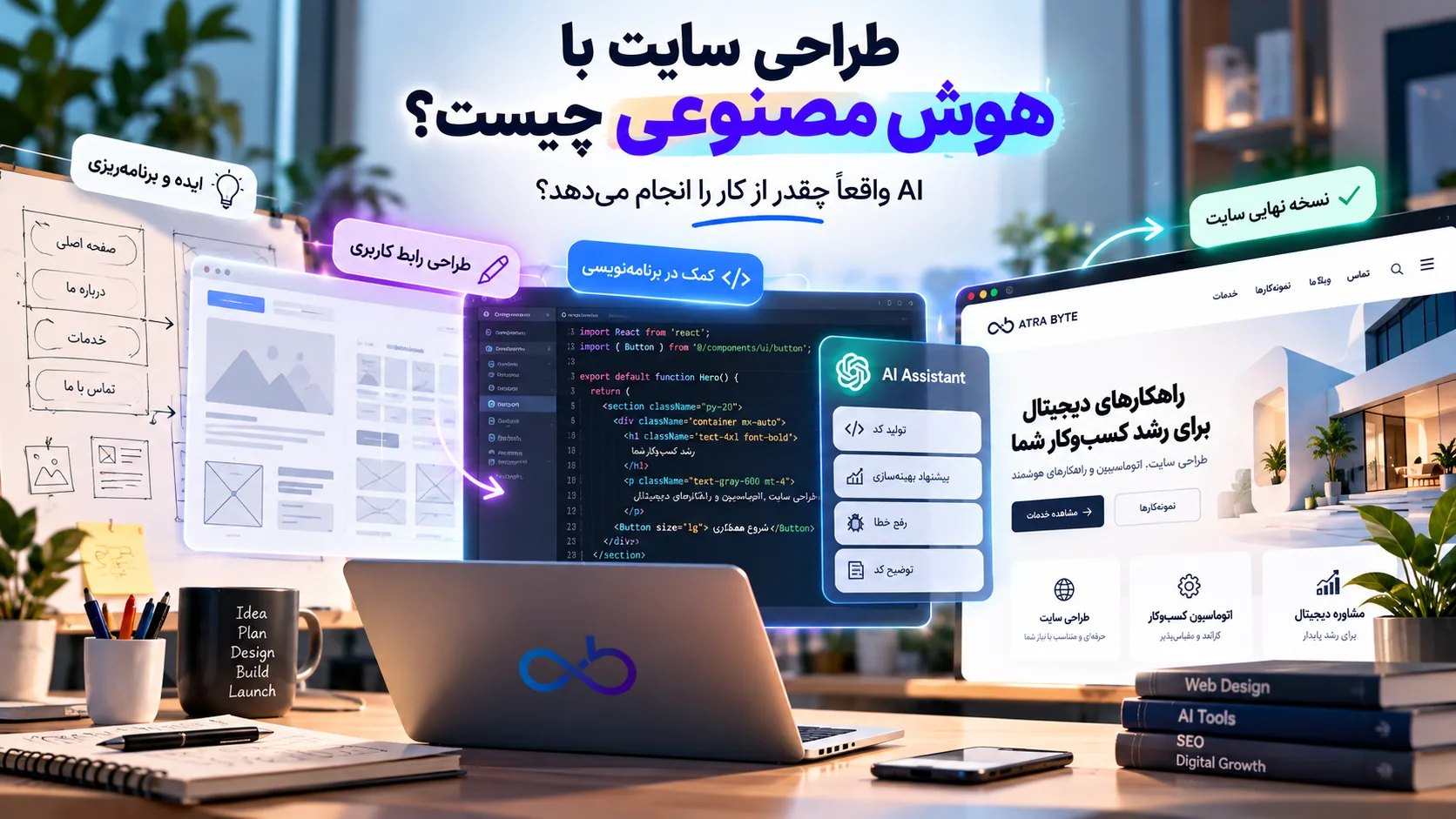
What Is AI Website Design?
A few years ago, building a website usually followed a familiar process: planning, design, development, content, testing and launch.
Today, you can ask an AI-powered tool to:
“Create a modern website for a coffee shop.”
Within moments, you may have a homepage, navigation, images, buttons and draft copy.
That naturally raises a question:
If AI can build websites, do we still need designers and developers?
The short answer is that AI can accelerate significant parts of the website creation process, but building a real website involves much more than generating attractive pages.
What Does “AI Website Design” Actually Mean?
AI website design can describe several different workflows.
An AI website builder may generate a website from a written description.
A designer may use AI for ideation, images or early layouts.
A developer may use AI to generate, explain, debug or test parts of the codebase.
So an “AI-designed website” does not necessarily mean that an artificial intelligence system built everything without human involvement.
In professional workflows, AI often works best as an assistant rather than an autonomous replacement.
What Can AI Do During Website Development?
AI can help with early ideas, page structures, UI concepts, draft content, coding, debugging and testing.
For developers, coding assistants can reduce time spent on repetitive work. In one controlled GitHub study involving 95 professional developers completing a specific JavaScript task, participants using GitHub Copilot completed the task faster on average. This result relates to that particular experiment and should not be interpreted as a universal speed increase for every software project.
Can AI Build an Entire Website?
For simple websites, prototypes and landing pages, AI tools can produce surprisingly useful results.
Complex applications are different.
An ecommerce website, for example, needs more than product cards and a checkout button. Developers need to consider inventory, payments, order states, authentication, permissions, customer data, integrations, failures and many other scenarios.
At this point, you are no longer simply generating pages.
You are designing a system.
Is AI-Generated Code Safe?
AI-generated code should not automatically be considered secure simply because it works.
OWASP's Secure Coding with AI guidance recommends assigning human ownership to AI-generated changes and requiring developer review and approval before those changes are merged or deployed.
AI can write code.
A human still needs to be responsible for that code.
What About SEO?
A website does not automatically gain or lose search visibility simply because AI was involved in its creation.
The final implementation matters.
Google needs to be able to discover, crawl, render and understand important pages. For JavaScript applications, Google documents how its systems process pages through crawling, rendering and indexing and provides technical recommendations for making those applications discoverable.
For ecommerce websites, Google also provides specific guidance on site structure, product information and structured data.
Does AI Reduce Website Development Costs?
Sometimes.
AI can reduce the time required for certain repetitive tasks, but project cost is not determined solely by the amount of code written.
Business analysis, architecture, UX, integrations, security, testing, deployment and maintenance all require time and expertise.
Two projects can use exactly the same AI tools and still have completely different complexity and costs.
Will AI Replace Web Designers and Developers?
A more useful question may be:
Which parts of their work will AI change?
AI is changing how professionals research, prototype, code and test.
That can allow specialists to spend more time on understanding the problem, choosing architecture, reviewing results, security and user experience.
AI can suggest a solution.
Someone still needs to know whether that solution is appropriate.
How We Use AI at AtraByte
AtraByte does not currently offer a standalone AI or AI Agent service.
We do, however, use AI tools during parts of our workflow where they can improve research, ideation, development and efficiency.
Architecture, development decisions, code review, testing and final delivery remain based on the actual requirements of each project and under human supervision.
For us, AI is not a replacement for expertise.
It is another tool in the expert's toolbox.
Conclusion
AI website design is already here.
AI can generate layouts, content and code and can accelerate several stages of web development.
But there is an important difference between generating a page and building a reliable digital product.
The most important question for a business is therefore not:
“Was my website built by a human or AI?”
It is:
“Does this website actually solve a problem for my business and my customers?”

Discussion
Thoughts on this article