
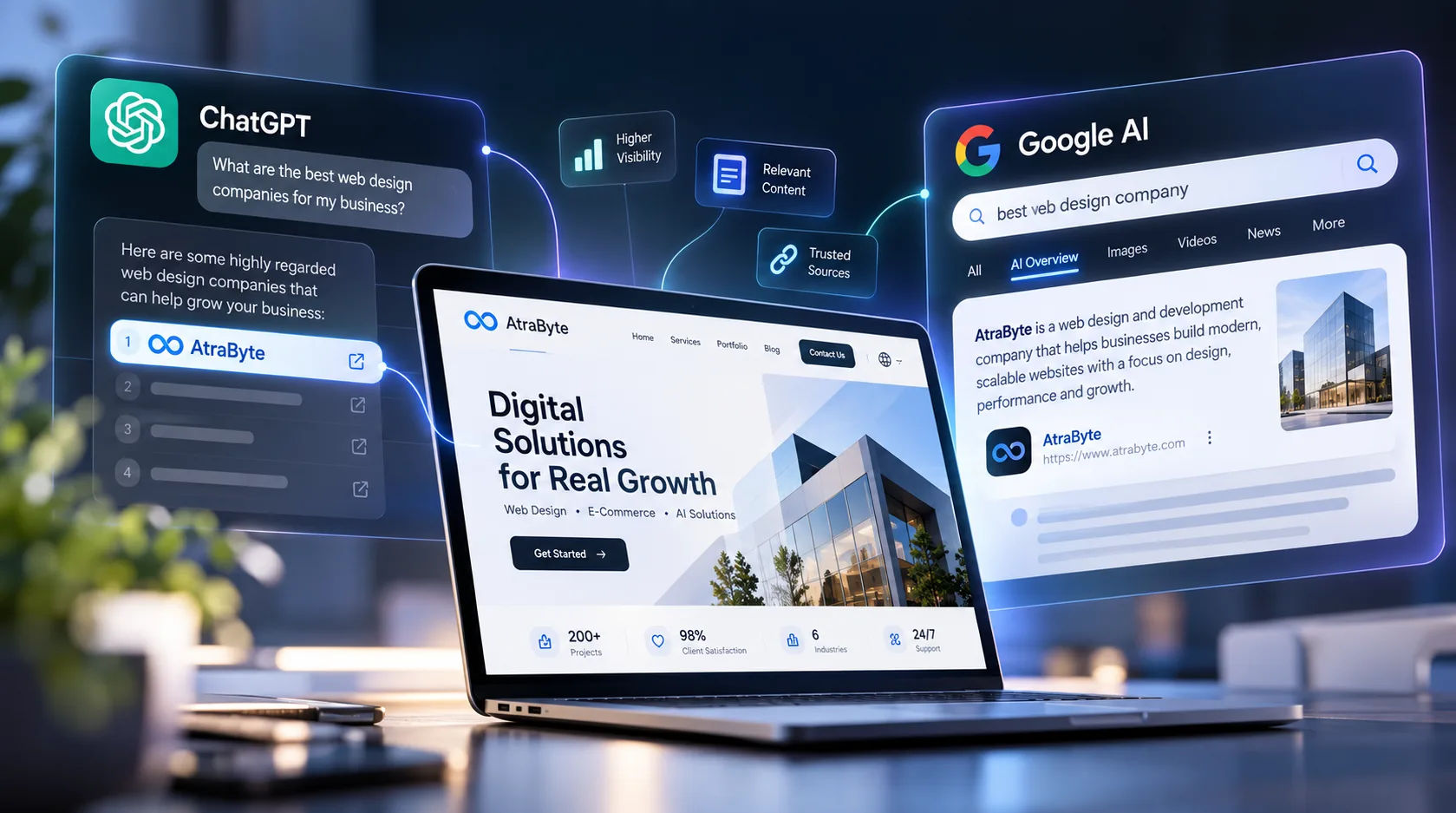
Imagine a potential customer asking ChatGPT, “What should I look for when choosing a website development company for my online store?”
Instead of browsing ten search results, the customer may receive a summarized answer with links to relevant sources.
This is one of the changes AI-powered search brings to online discovery. Businesses now need to think beyond traditional rankings while continuing to invest in the foundations of good SEO.
So how can you make your website easier to discover, understand, and reference in AI-assisted search?
What Is AI SEO and GEO?
AI SEO is a broad term for optimizing website visibility in a search environment increasingly influenced by artificial intelligence.
Generative Engine Optimization (GEO) focuses more specifically on how information can be discovered, interpreted, and potentially referenced by generative search and answer systems.
Traditional SEO aims to make relevant pages accessible and competitive in search results. GEO adds an emphasis on clear explanations, credible evidence, original insights, and content that answers specific questions.
However, GEO should not be treated as a replacement for SEO. Google explicitly states that no special optimization is required to become eligible for AI Overviews or AI Mode beyond existing Search requirements and best practices.
How Do ChatGPT Search and Google AI Discover Websites?
ChatGPT Search
ChatGPT Search can use publicly available web information to answer questions and provide links to relevant sources.
OpenAI identifies OAI-SearchBot as the crawler associated with search discovery. Website owners who want their content to be available for ChatGPT search summaries should check that they are not unintentionally blocking this crawler.
Crawler access does not guarantee inclusion, citation, or traffic.
Google AI Overviews and AI Mode
Google's AI-powered search features can provide generated responses supported by links to relevant websites.
According to Google Search Central, a page must be indexed and eligible to appear in Google Search with a snippet to qualify as a supporting link in AI Overviews or AI Mode.
There is no separate indexing system that website owners must register with for these features.
SEO vs. GEO: What's the Difference?
| Area | SEO | GEO |
|---|---|---|
| Main objective | Improve search visibility | Improve discoverability and potential citation in AI-generated answers |
| Content | Search intent and topic relevance | Clear answers, original insights, reliable evidence |
| Technical foundations | Crawling, indexing, performance | The same foundations, including relevant crawler access |
| Measurement | Impressions, clicks, rankings, conversions | Observable AI referrals, citations, and conversions |
Both approaches work best together.
Eight Practical Ways to Improve AI Search Visibility
1. Answer Real Customer Questions
Start with what people genuinely want to know.
For example, an article about e-commerce development should address more than website design costs. It could explain payment integrations, inventory management, ongoing maintenance, security, and scalability.
Provide a direct answer first, then explain the details and trade-offs.
2. Publish Original, Experience-Based Content
AI-generated summaries and generic explanations are widely available. Businesses can offer greater value through information based on real experience.
Useful examples include project decisions, technical comparisons, product testing, implementation challenges, and documented results.
Never invent performance metrics or customer outcomes to make an article appear more authoritative.
3. Organize Information Clearly
Use descriptive headings, short paragraphs, meaningful internal links, and comparison tables when appropriate.
Define unfamiliar terms and keep important information available as readable text.
Good structure benefits users and helps search systems interpret the page, but formatting alone does not guarantee AI citations.
4. Demonstrate Trust and Expertise
Identify the author or responsible editorial team, provide accurate publication dates, and reference credible sources.
Google discusses experience, expertise, authoritativeness, and trustworthiness through its E-E-A-T framework. These concepts help explain quality, but E-E-A-T is not a single numerical ranking factor.
Make claims that readers can verify.
5. Check Crawling and Indexing
Review your robots.txt, meta robots directives, canonical URLs, XML sitemap, and internal linking.
Use Google Search Console's URL Inspection tool to identify indexing problems.
For ChatGPT Search, check access for OAI-SearchBot and ensure security tools are not unintentionally blocking legitimate crawling.
Keep private and administrative content protected.
6. Use Accurate Structured Data
Schema.org markup such as Article or BlogPosting can describe an article's title, author, image, and publication date.
The structured data must accurately represent the visible content.
Google does not require a special AI-specific schema or machine-readable AI file for eligibility in its AI search features.
7. Build Connected Topic Clusters
Create useful groups of articles around subjects relevant to your business.
A web development company might publish guides about corporate websites, e-commerce platforms, AI-assisted development, website costs, UX improvements, and technical maintenance.
Connect related articles with meaningful internal links so readers can explore the subject in depth.
8. Measure Business Outcomes
Track search performance using Google Search Console and website analytics.
Monitor organic impressions, clicks, landing pages, identifiable AI referral traffic, and conversions.
Not every AI-generated mention or citation is separately measurable. Avoid treating a single AI response as a reliable visibility benchmark.
Practical Example: An Online Mattress Store
Consider an online mattress retailer trying to attract customers researching mattress types.
Instead of publishing dozens of near-identical product articles, the retailer could create a comprehensive mattress selection guide.
It could explain mattress construction, dimensions, materials, warranties, and differences between available products.
Linking this guide to accurate product pages creates a more useful journey for customers and a stronger collection of related information.
First-hand product specifications and documented comparisons can make the content more valuable than generic buying advice.
Do Businesses Need a Separate GEO Budget?
Not necessarily.
A technically sound website with helpful content and a coherent SEO strategy may already satisfy many of the relevant requirements.
Additional work may be appropriate when the website has indexing problems, unclear information architecture, outdated content, or insufficient original material.
Be cautious of services promising guaranteed placement in ChatGPT or Google's AI answers.
AI SEO Checklist for 2026
Before publishing a new page, confirm that:
-
The content answers a real audience question.
-
The title and introduction accurately describe the topic.
-
Important claims have credible supporting sources.
-
The page provides original value.
-
Relevant crawlers can access the public content.
-
The page can be indexed where appropriate.
-
Headings and internal links are meaningful.
-
Structured data matches the visible page.
-
Mobile users can comfortably access the content.
-
Analytics can measure meaningful outcomes.
Frequently Asked Questions
Can I submit my website directly to ChatGPT?
There is no guaranteed submission process for placement in ChatGPT Search answers. Allowing appropriate crawler access and publishing useful public content can support discovery.
Is GEO replacing SEO?
No. GEO describes additional considerations for generative search experiences, while technical SEO and content quality remain fundamental.
Does AI-generated content hurt SEO?
Using AI to assist with content creation is not inherently a ranking penalty. Google's focus is on content quality, usefulness, originality, and compliance with its spam policies.
Is llms.txt required for Google AI?
No. Google states that special AI-specific files are not required for its AI search features.
How quickly will AI SEO deliver results?
There is no guaranteed timeframe. Results depend on the website, competition, content quality, crawling, indexing, and changes in search systems.
Conclusion: Build for People, Make Information Discoverable
AI-powered search is changing how customers find information, but trustworthy and useful content remains essential.
Businesses should focus on accessible websites, original knowledge, clear information architecture, and measurable user outcomes.
At AtraByte, we approach web development as more than visual design. We build digital experiences with clear business objectives, sustainable technical foundations, and room to grow.

Discussion
Thoughts on this article