Business Automation
Business Automation and Custom Intelligent Systems
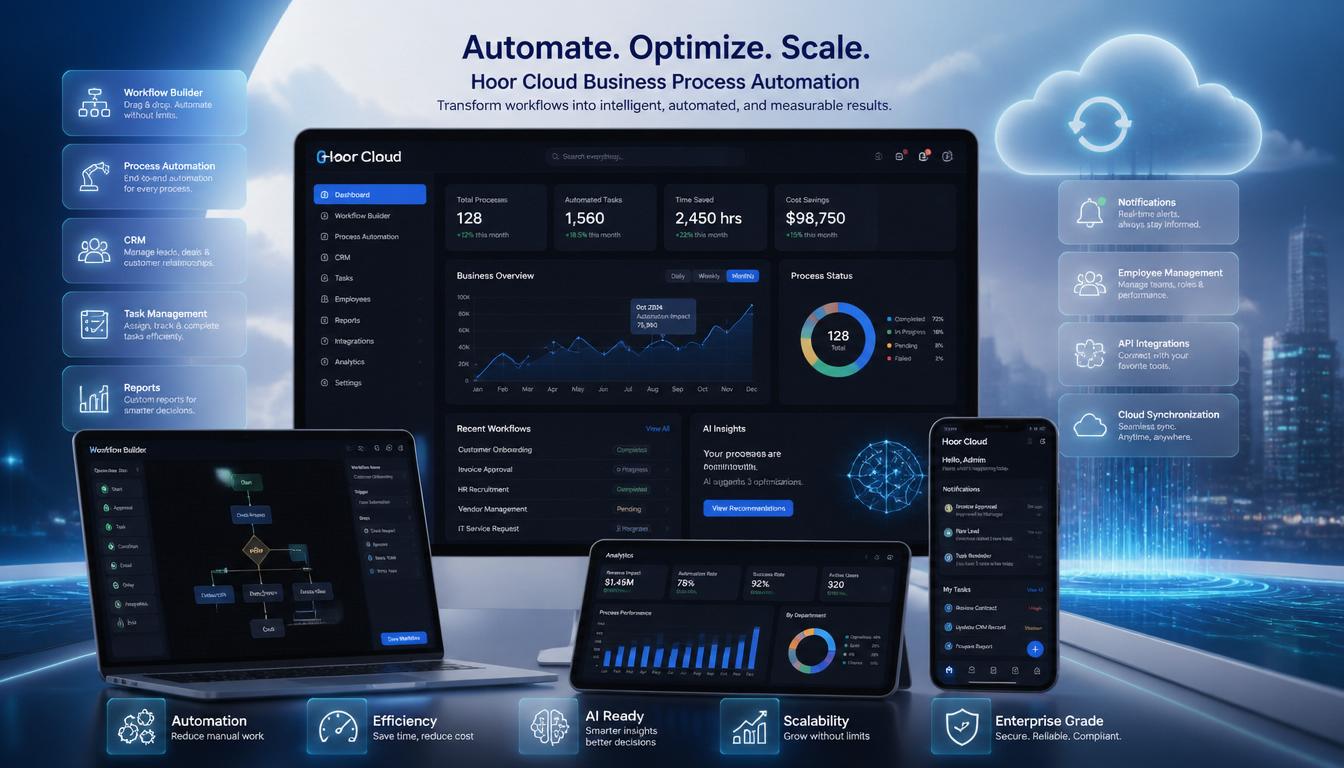
Design and development of business automation systems to eliminate repetitive tasks, increase productivity, reduce errors, and intelligently manage business operations.
- Custom System Development
- Automation of Repetitive Processes
- Intelligent Workflow Automation
- Management Dashboard
Solutions that work
01
About this service
Strategy, design and technology working together.
Business Automation: When Software Works for You
In many businesses, a significant amount of employees' time is spent on repetitive tasks, data entry, following up on requests, sending files, preparing reports, and coordinating between departments. In addition to consuming valuable time, these activities also increase the risk of human error.
Business automation transforms manual processes into digital workflows, allowing many of these activities to be performed automatically. The result is greater speed, lower costs, higher accuracy, and better information management.
At AtraByte, automation systems are designed around the real processes of each business rather than forcing organizations into predefined templates.
Who Is This Service For?
This service is suitable for companies, factories, stores, educational institutions, clinics, law firms, service companies, startups, and any organization where part of the daily operations is still handled manually.
Business Process Analysis
Before software development begins, existing business processes are analyzed to identify time-consuming activities, bottlenecks, human errors, and actual operational requirements.
The goal is not simply to build software. The goal is to make work easier, faster, and more efficient.
Custom System Development
Every organization has its own processes and requirements. For this reason, each system can be designed specifically around the needs of the business.
Example modules include:
- Customer Relationship Management (CRM)
- Project management
- Order management
- Contract management
- Personnel management
- Inventory management
- Financial management
- Request management
- Correspondence workflows
- File management
- Reporting
- Management dashboards
Automating Repetitive Tasks
The system can automatically perform many routine activities, including:
- Sending SMS messages
- Sending emails
- Generating invoices
- Registering requests
- Generating reports
- Sending task reminders
- Updating case or request statuses
- Notifying users
- Updating information
Workflow Automation
Clear stages can be defined for each business process.
For example:
Request submission → Review → Manager approval → Execution → Delivery → Archive
Every stage is recorded, allowing the status of each request to be tracked at any time.
Management Dashboard
Managers can monitor important business information through a centralized dashboard.
Examples include:
- Number of orders
- Active projects
- Employee status
- Revenue
- Expenses
- Performance reports
- Charts and visual reports
- Alerts
- Key performance indicators
User Management and Access Control
Different roles and permission levels can be defined so that each user has access only to the information and features required for their responsibilities.
Integration with Other Systems
The automation system can be integrated with different platforms and services, including:
- Websites
- E-commerce platforms
- Accounting systems
- SMS services
- Email services
- Payment gateways
- External APIs
- Internal organizational software
Intelligent Reporting
Recorded information can be transformed into useful operational and management reports.
Managers can access analytical reports, charts, Excel and PDF exports, as well as custom reports tailored to the organization's requirements.
Document Automation
Forms, contracts, letters, and other documents can be managed digitally.
Document versions, approval status, and change history can also be recorded and tracked.
Notifications and Reminders
The system can automatically send notifications at scheduled times or when specific events occur.
Examples include:
- Contract expiration
- Upcoming payment deadlines
- New order registration
- Approval requests
- Low or depleted inventory
- New task assignments
Responsive Design
The system can be used on smartphones, tablets, and desktop computers, allowing users to access the information they need from different devices and locations.
Information Security
Organizational information is valuable and must be protected. The system is designed according to appropriate security principles and can include features such as:
- Authentication
- Role-based access control
- User activity logging
- Backups
- Secure communications
Future Scalability
The system is designed with a modular and scalable architecture so that new features and sections can be added as the business grows without requiring a complete redesign.
Depending on the organization's future requirements, the system can be expanded with features such as:
-
New custom modules
-
Expanded customer and user portals
-
Additional analytical reports and dashboards
-
Advanced workflows and organizational processes
-
Integration with websites, e-commerce platforms, and online services
-
Integration with SMS, email, and payment services
-
Expanded Customer Relationship Management (CRM) capabilities
-
Excel and PDF export features
-
Additional roles and permission levels
-
New capabilities based on the future growth and requirements of the business
At AtraByte, systems are built with scalable architectures that allow new capabilities to be added as the business grows without disrupting existing operations. This approach helps ensure that the software remains useful and adaptable as the organization's requirements evolve over time.
02
Key benefits
Why this service?
Automation of Repetitive Processes
02Intelligent Workflow Automation
03Management Dashboard
04User Management
05Analytical Reports
06Integration with Other Systems
07Advanced Security
08Scalable Architecture
09Responsive Design
10
03
Our process
From idea to final product
A clear and transparent process from start to finish.
-
01
Business Process Analysis
Existing processes, requirements, challenges, and repetitive activities are analyzed to determine the appropriate structure for the system.
-
02
System Architecture Design
Modules, user roles, access levels, workflows, and the interactions between different parts of the system are designed.
-
03
User Interface Design
Pages, forms, and dashboards are designed with a focus on simplicity, speed, and an efficient user experience.
-
04
Software Development
The core components and required features of the system are developed and implemented based on the approved architecture.
-
05
Service Integration
Where required, the system is integrated with supported services such as SMS, email, payment gateways, websites, and APIs.
-
06
Testing and Quality Assurance
System functionality, access permissions, forms, reports, and workflows are tested to identify and resolve potential issues.
-
07
Initial Data Setup
Basic information, users, categories, settings, and other required initial data are configured and entered into the system.
-
08
User Training
Users are trained to operate the system, manage information, view reports, and perform their daily workflows.
-
09
System Deployment
The final version is deployed to the designated server and domain, and the required configuration for production use is completed.
-
10
Support and Further Development
After deployment, support, issue resolution, and the development of new features can be provided according to the organization's evolving requirements.
REAL IMPACT
Your project could be our next success story.
04
FAQ
Answers to your questions
Still have a question? Get in touch.
No. Each system is designed and developed based on the actual requirements and processes of the business.
Yes. Where technically feasible, the system can be integrated with your existing website or software.
Yes. The system architecture is designed to be scalable so that new modules and features can be added as requirements evolve.
Yes. Dedicated access permissions can be defined for each organizational role.
Yes. Management reports, Excel and PDF files, and analytical dashboards can be generated from the recorded data.
Yes. The system is designed to be fully responsive and usable across smartphones, tablets, and desktop devices.
Yes. The system is developed according to appropriate security standards and can include authentication, access control, and user activity logging.
Yes. The system architecture can be designed to support future capabilities such as intelligent analysis, AI assistants, and predictive data analysis.
LET'S BUILD WHAT'S NEXT
Ready to get started?
Tell us about your project and let's take the first step.